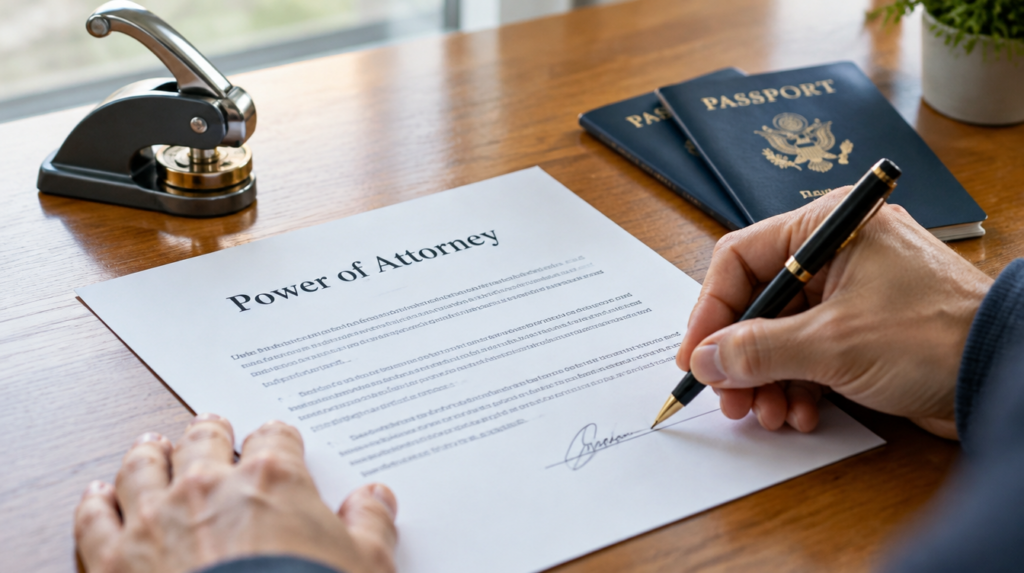
A power of attorney is one of the most common documents that needs a Texas apostille, and one of the easiest to get wrong. Say you’re in Katy and need a sibling in Mexico to sell the family house, or you’re in Houston and need a parent in India to handle a bank matter. The paperwork is simple. The apostille step trips people up because a POA isn’t a government record; it only becomes eligible once a Texas notary has done their part correctly.
Need a Texas apostille? We handle it for you.
Our Texas apostille service checks your document, notarizes it if needed, files it with the Texas Secretary of State and sends it back to you. Rush in 1–3 business days. In Houston? See our Houston apostille service.
Here’s the short version, then the details.
How do you apostille a power of attorney in Texas?
To apostille a power of attorney in Texas, sign the POA in front of a commissioned Texas notary, then submit the original notarized document to the Texas Secretary of State with a request form naming the country where it will be used. The Secretary of State attaches an apostille that foreign authorities in Hague Convention countries will recognize.
Each of those steps has a way to go wrong, which is why this post exists.
Why the notarization is the part that matters
The Texas Secretary of State apostilles two kinds of things: public records issued in Texas (birth certificates, court documents) and documents notarized by a Texas notary. A power of attorney falls in the second group. The SOS calls these “non-recordable” documents, and their rule is plain: the document “must be properly notarized with a true and accurate notarial certificate, notary signature, seal, and date of notarization.” (Texas SOS, Authentications overview)
What the apostille actually certifies is the notary. Not you, not the POA’s contents. The SOS confirms that the notary who signed and sealed your document holds a valid Texas commission. If the notarization is sloppy, there’s nothing for the state to certify.
A few things I check before I file a POA, because the SOS will send it back otherwise:
- The signer’s own signature is on the document. The SOS is specific that a notary “cannot make statements on behalf of signers; only the signer may do so, such as in a power of attorney.” You (the principal) sign. The notary witnesses and certifies.
- The notarial certificate is complete. An acknowledgment wording, the notary’s signature, the seal, and the date. Missing any one of these is a rejection.
- It’s the original. The SOS states it does “not apostille copies of certified or notarized records.” A photocopy of a notarized POA will not work, no matter how clean the scan is. (Texas SOS, How to Request a Universal Apostille)
- It was notarized in Texas by a Texas notary. The state “is not able to authenticate or apostille documents issued from other states or countries.” If you signed in front of a Louisiana notary, Louisiana has to apostille it.
One more that catches Spanish-speaking clients: any document carrying the words “Notario Publico,” or a notary statement that goes beyond what a Texas notary is allowed to do, gets rejected. A Texas notary public is not a notario in the Latin American sense and can’t act like one.
Step by step: Texas power of attorney apostille
- Get the POA drafted for the country that will use it. This is the step most people skip. Mexico, for example, has its own POA formats, and a foreign bank or notary may refuse a generic U.S. form even with a perfect apostille. Have whoever is receiving the document (usually the lawyer or notario abroad) tell you exactly what wording they need. I notarize what you bring; I can’t draft it for you, and neither can any Texas notary.
- Sign it in front of a Texas notary. Bring a valid government photo ID. If you’re in the Houston area, I’ll come to you. If you’re elsewhere in Texas or outside the state, we can do this by remote online notarization, which the Texas SOS does accept for apostilles, with one caveat I’ll get to below.
- Fill out the request form. The Secretary of State’s Form 2102 (Request for Official Certificate or Apostille) needs the destination country. The SOS says flatly that you “must indicate the country where the document will be used,” and they won’t apostille anything meant for use inside the United States.
- Submit the original to the SOS in Austin. By mail, the SOS quotes an estimated two-week turnaround from the day they receive it. In person, it’s same-day. This is where we come in: I hand-file at the Authentications Unit at 400 West 15th Street in Austin, so a rush order comes back in 1 to 3 business days and standard service in about a week.
- Send the apostilled POA abroad. The apostille is physically attached to your document. Don’t remove the staple or separate the pages; a detached apostille is usually treated as invalid.
Do you need a translation?
Often, yes, but the apostille itself is not the translation. Either the POA is drafted bilingually from the start (what I’d suggest for Mexico and most of Latin America), or you have a translator sign a statement in front of a notary. The SOS will apostille a notarized translation, but “the document being translated must be submitted with the notarized translation.” (Texas SOS, Authentications FAQ) Ask the receiving party which route they want before you pay for either; some countries prefer a translation done locally after the apostille arrives.
Online notarization and foreign countries
Texas accepts remote online notarized documents for apostille as long as the notarial certificate states the signing was done “by two-way audio and visual communication” and the notary’s ledger is included. But the SOS adds a warning on its own site: “some countries do not accept online (RON) notarized documents, even if properly authenticated by our Office.”
Texas will apostille a RON power of attorney. Whether the bank or court on the other end will honor it is a separate question. For a POA that’s going to be used to sell property or open accounts, I’d rather meet you in person and notarize with wet ink than have the document bounce abroad after the apostille is already on it. If in-person isn’t possible, get the recipient to confirm in writing that an electronically notarized document is acceptable.
Hague or not?
The Texas apostille is a “universal” certificate. For countries that belong to the Apostille Convention (Mexico, India, the Philippines, Colombia, Brazil, China, and Canada are all on the list), it is the last step. You can check any country on the HCCH status table.
For countries that are not members, the SOS notes you’ll likely need the certificate validated by the U.S. Department of State and then the destination country’s embassy. We don’t handle that federal and embassy step, but we’ll get the Texas portion done correctly so the rest can proceed. I cover the difference in more depth in apostille vs. authentication for non-Hague countries.
What we do for you
Anywhere in greater Houston, I’ll meet you to notarize the POA and take the original from there. From Dallas, San Antonio, Austin, and the rest of Texas, you mail the notarized original to us. Either way, it’s hand-filed at the Secretary of State in Austin, not dropped in the mail queue.
Call or text 832-741-3190 and tell me the destination country and when you need it back. See our Texas apostille service page, or the local pages for Houston and Dallas.
Frequently asked questions
Can I apostille a power of attorney that I signed in another state?
No. The Texas Secretary of State only apostilles documents notarized by a Texas notary or issued by a Texas agency. A POA notarized in another state has to be apostilled by that state’s authority.
How long does a Texas power of attorney apostille take?
Mailed requests to the SOS take an estimated two weeks after receipt. Because we file in person in Austin, rush orders return in 1 to 3 business days and standard orders in about a week. More detail in how long an apostille takes in Texas.
Can a Texas notary write the power of attorney for me?
No. Texas notaries are not permitted to draft documents or choose the notarial certificate for you. Have an attorney, or the party receiving the POA abroad, prepare the wording. Then bring it to a notary to sign.
Does the SOS apostille a copy of my POA?
No. The SOS requires the original notarized document. If you need the POA in two countries, sign two originals and apostille each one.